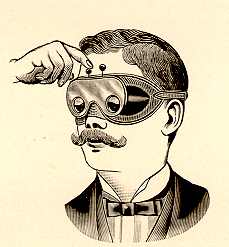
Removing the Hoodwink of the Self

One of the major themes in my spiritual path, and my life in general, has been the search for the real “me”. While this may seem like a simple task, it actually takes a great deal of work and courage to undertake, because what lies beneath our polished exterior can actually be a jumbled mess of insecurities, repressed thoughts and memories, and unsavory thoughts and tendencies.

When most people ask themselves the question of, “who am I?”, usually they will describe various attributes for themselves. For example, I could answer: I am a lawyer, I am married, I am a father, I am a Freemason, I am from a small town in Oklahoma, I like ____, I dislike_____, etc. but is that really who “I” am? Am I simply an amalgam of my career, family life, likes & dislikes, and life experiences? Well… the answer that I have discovered is “Yes and No”. While I am a product of these various attributes, they are not the true me, rather they make up the outer-shell of my true-self in the form of my personality, and the various masks that I use in order to fit in with my roles and with society in general. In order to find the true “me”, I must dig deeper…

In order to discover who "you" truly are, you must be willing to strip away the hoodwink of the ego that keeps you in the perpetual darkness of fear and uncertainty. You must also be willing to really examine the various layers and masks (your various personas) that you have built up around your true-self. This can be a long task, because many of our layers and masks begin to develop in early childhood, and continue to be layered upon and modified as we grow older. Perhaps we defined our niche as the popular kid in school, the smart kid, the athlete, the class clown, the dramatic kid, the loner, etc. These masks helped us to fit in, or protected us in various ways. For example, as an identical twin I constantly tried to define myself as unique and different from my brother, sometimes to the point of causing conflict and strife just to prove that I was different and unique. I am told that this phenomena is extremely common with twins, and by understanding that and embracing it, I have gained an important piece to the puzzle of “me”.

Our various personas are not necessarily a bad thing, and in fact sometimes they are helpful; however, the key is to actually examine these various layers and masks, and discard the ones that are stifling us from achieving our maximum potential in both the physical and spiritual realms. This can be done by simply observing our actions, attitudes, and thoughts in various situations. Do we act one way at work, and another way with friends, family, at Lodge, or at church? Why do we feel the need to put on these different masks? Are we being inauthentic by putting these masks on? Is there a time when we can truly be released from our self created hoodwinks and cable tows? By examining and stripping away the negative or repressive layers and masks, we can begin to discover and understand our true-self, our true essence, which is the divine spark from God, our soul. In Freemasonry this honing of the self is allegorically represented by the continual shaping of the ashlar, from the rough ashlar of the Entered Apprentice, to the perfected lapis of the Master Mason. 

For now I will keep working at removing my own psychological and spiritual hoodwinks, and while I'm sure that I still have a long road to travel, I'm blessed to have brothers in our fraternity that will be my companions and psychopomps in the journey. Light added to Light.

PRACTICAL TIP: When you are in a situation and you feel that you are having to “act” in some way, examine why you feel the need to act in a certain way. Why are you having to adopt a certain persona? Examine what the cause is for that mask, and try and discard the mask in order to be genuine. Also, when you have certain preconceptions or stereotypes, examine the root cause of those thoughts and feelings.

_______________________________________

THANK YOU FOR READING THE LAUDABLE PURSUIT!

IF YOU ENJOYED THIS PIECE, PLEASE FEEL FREE TO SHARE IT ON SOCIAL MEDIA SITES AND WITH YOUR LODGE.

For more information on Wor. Jason E. Marshall, Please CLICK HERE:

Also, visit us on Facebook: https://www.facebook.com/TheLaudablePursuit

_______________________________________

SHOW YOUR SUPPORT
If you enjoyed this content, you can show your support by visiting the "Support TLP" page in the header, or by clicking the button below.
Support TLP


Masters & Past Masters: The Real Role of These Worshipful Men

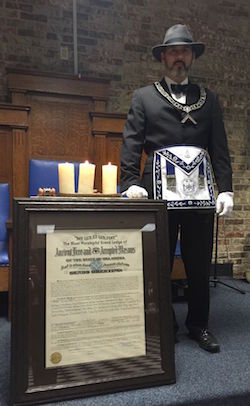
Wor. Micahel A. Rose, after being installed as Master of Veritas Lodge No. 556, Norman, Oklahoma.

Wor. Micahel A. Rose, after being installed as Master of Veritas Lodge No. 556, Norman, Oklahoma.

We often encounter problems when words describing ancient concepts are translated by language of today. The choice and definition of words which were popular a few centuries ago in interpreting ideas or rendering meaning to everyday subjects often seem archaic and/or misleading when used in a contemporary sense. A typical example of this problem in the language of Freemasonry applies to the titles of our principal lodge officers.

For instance, a Master Mason is a brother who has been regularly initiated, passed and raised in a legally constituted lodge of Free and Accepted Masons. But, in the 15th century, a Master Mason was a workman who was qualified by training and experience to teach his trade to a younger, inexperienced worker. He was a man of approved learning; a scholar of authority.

The title of Worshipful Master is the term given today to mean the presiding officer of a Masonic lodge. But in the 1500’s such a title meant honorable and reputable; applying to a person who was distinguished in regard to character or rank; entitled to honor and respect. By the 1700’s, to call a man worshipful was an honorific and often temporary designation; applying to persons or bodies of distinguished rank or importance. When the title worshipful became attached to the word master, the two together denoted a man of great honor, integrity and learning who also had control or authority over something or someone. Justices of the peace, aldermen and mayors, governors and rulers; all carried the title of his worship, or worshipful master.

A Passed (or Past) Master is a Master Mason who is no longer the installed Master of a lodge of Freemasons. He has “passed the chair” as the presiding officer of his lodge. But in the 16th century, a Passed Master was one who had been examined and passed as a Master; and was thereafter considered a highly qualified or accomplished Master of a trade, guild, society or corporation.

Today, the Past Masters, Worshipful Masters and Wardens (the traditional gatekeepers or sentinels of the realm, and later the regents who ruled in the King’s absence—now vice presidents of the lodge), in addition to their hierarchical status within the structure of a lodge, also make up the body of the Grand Lodge, or state assembly of Masons, and are given the authority, on behalf of all members of their lodge, to collectively adopt the rules and regulations which govern all lodges in the state. These titled men represent the voice of the Grand Lodge when the Grand Lodge is not in session. This is the reason lodges can operate independently from Grand Lodges. Each lodge is a microcosm of the whole.

This is the hierarchical nature of the fraternity of Free and Accepted Masons, and its authority in regard to the function and leadership of each lodge.

However, titles alone do not address the more important function of these offices in regard to the fraternity’s ceremonies of initiation, passing, and raising. There must also be a transmission of knowledge, wisdom and insight in order for the new Mason to be transformed by his experience. The officers of the lodge are the metaphysical agents for this transmission. Thus, the meanings of the ancient titles are carried forth by the honored men who presently carry these titles to those who are undertaking the process of becoming Masons.

The Entered Apprentice (Initiate) must be bathed in the pure and moral motive of the light; the Fellow of the Craft must be passed into an intellectual understanding of light; and the Master Mason must be raised by that light to an insight of truth which transcends rational intellectualism. This spiritual transmission can only occur through an agent who is capable of knowing and honoring the spiritual sanction and sacred lineage of his office.

Herein is a serious caveat of which we, as Masons, must be always vigilant.

The man who ascends to the East in his lodge, professing to know Masonry; yet knowing only the words of the ritual without any understanding of his role as the Initiator for the lodge, is not capable of transmitting the esoteric and metaphysical attributes of the inner work to the psyche of the Initiate. He has neither qualified himself as a Master, a man of scholarly authority in the mysteries; nor as worshipful, a man distinguished by the singularity of his spiritual understanding.

Having offered the above as only a caution, in the traditional sense, I believe the titles of Worshipful Master and Past Master carry much weight when properly understood. They are, and remain, honorable and not temporal in that those who have the titles are styled “Worshipful;” and are therefore invested with the responsibility of being the teachers of Masonry, and carrying the spiritual lineage of the lodge with them for all time.

Therefore, I think these titles were never intended to be given frivolously, but should be earned by work, study, contemplation, and lasting commitment to the ideal of awakening the consciousness of humankind; the unveiling of the mysteries. This is the reason that only the most qualified and capable of the Master Masons should ever hold these offices.

Likewise, only those who are “duly and truly prepared” should strive to become a part of the elect group. To be initiated, passed and raised, one must first be receptive to receive the transmission offered by a Master or Past Master.

For, without transmitting and receiving this sacred gift of spiritual light; nothing much changes for any of us.

________________________________________

THANK YOU FOR READING THE LAUDABLE PURSUIT!

IF YOU ENJOYED THIS PIECE, PLEASE FEEL FREE TO SHARE IT ON SOCIAL MEDIA SITES AND WITH YOUR LODGE.

For more information on Wor. Robert G. Davis Please: CLICK HERE

Also, visit us on Facebook: https://www.facebook.com/TheLaudablePursuit

_______________________________________

SHOW YOUR SUPPORT
If you enjoyed this content, you can show your support by visiting the "Support TLP" page in the header.

SUPPORT TLP

Fraternalism--The Lost Word in Charity

Any study of the beginnings of Freemasonry will clearly show that fraternalism was the first and most distinguishing characteristic of Masons and Masonry. We are, above everything else, our own brother’s keeper. This has been the raison d’ etre which distinguishes us from all other groups.

Masonic charity, in its original terminology, meant fraternal, or private, charity—and is represented by the meaning of Brotherly Love and Relief in the great Masonic triad of Brotherly Love, Relief, and Truth. It is “the cement which unites us into one common band, or society, of friends and brothers.” 

Our obligations are obligations we have taken on behalf of each other. Our moral, social and financial duties are first and foremost to our brothers, their family members and survivors. In the ties and duties we received at the altar of Masonry we swore “to help with generous care all those in sorrow hidden; the brother on the darkened square….while tears gush forth unbidden ”

The admonition we get from the lodge Master in his opening charge, “let us be happy ourselves,”has everything to do with our kindness and brotherly affection toward each other. We are reminded of this again in the installation of officers: “we have one aim; to please each other and unite in the grand design of being happy and communicating happiness.”

Until the Shrine of North America institutionalized Masonic charity in 1922 by introducing an outside cause into Masonry, Masons always took care of their brothers and families first. They understood the traditional meaning of fraternity and fraternalism.

But institutional charity was appealing. It felt good to help others outside the lodge, and even better when that effort was directed at mitigating childhood misfortune. So, on the coattails of the good publicity the Shrine received nationally, we decided to move our charitable hearts beyond the confines of our lodges. It didn’t happen all at once; like some passing fad. It was a one lodge at a time inspiration which just kept growing across the landscape of communities.

Of course, it wasn’t long until the Masons also discovered it was much easier to tell their friends about Masonry by pointing to what we did, rather than explain what we were. Too, it was much easier for the public to discover and accept us when we were doing things they could see, rather than wonder what we were up to behind our closed doors.

By the 1950’s, this public charity thing had become an exciting partnership for all Bodies of Masonry. It felt good. It was convenient.

We should have known where all this would take us; but we didn’t pay much attention. As our lodges continued to grow in numbers, it became more difficult to stay intimately connected with every lodge member. In American Freemasonry, bigger was perceived as better. Especially in the larger urban areas, there was a kind of competition among lodges as to which would have the most members. It became nothing to boast of a lodge membership exceeding 500 brothers. The largest lodges had more than 5,000. It was no wonder outside charity became more important. It was simply much easier to apply our charitable dollars to outside causes than to stay on top of the needs of our own brothers, their widows, and children. Besides, the publicity was better; and the positive public image was both appealing and tempting.

Our brothers in need didn’t really know what was lost to them. The process of moving our charitable focus from inside our lodges to the outside world was so gradual, so subtle, we didn’t even realize when we had corporately lost the single most important tangible benefit of being a Mason—that we and our surviving families would have the security of Masonic aid and assistance for as long as we lived. The new reality is, in many lodges, the faithful few who regularly attend meetings rarely know those who don’t--let alone their human condition. Yet the lodge community charitable program is often firmly established and well known. In my own state, 227 lodges gave $2.7 million to community causes last year. That’s no small change.

In retrospect, with the increasing mobility of our society over the past few decades, who’s to know whether this has been a good or bad thing. Maybe we would not have retained our intimate connections anyway. Perhaps we would not have survived without better public contact and the improved public image that good works create.

This is really not the main concern of this musing anyway. To me, the scary thing is that it took only three generations of men to change a 400 year tradition. It makes one wonder how many other Masonic traditions have been lost to time only because a current generation had not a clue about the past.

________________________________________

THANK YOU FOR READING THE LAUDABLE PURSUIT!

IF YOU ENJOYED THIS PIECE, PLEASE FEEL FREE TO SHARE IT ON SOCIAL MEDIA SITES AND WITH YOUR LODGE.

For more information on Wor. Robert G. Davis Please: CLICK HERE

Also, visit us on Facebook: https://www.facebook.com/TheLaudablePursuit

_______________________________________

SHOW YOUR SUPPORT
If you enjoyed this content, you can show your support by visiting the "Support TLP" page in the header.

Support TLP